Darkroom Photography Clipart Kit Review
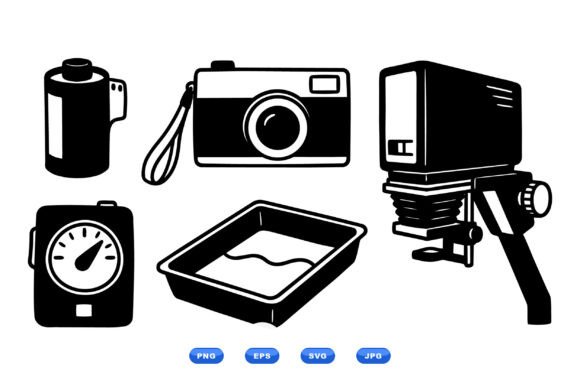
As a designer who spends more time staring at stitch charts than actual photographs, I approach every new embroidery file with a healthy dose of skepticism. We have all seen designs that look pristine in vector form but fall apart when the needle hits the fabric. Today, I am evaluating the Darkroom Photography Clipart Kit, a collection that promises minimalist vector silhouettes of classic darkroom equipment. Specifically, we are looking at an enlarger camera, film canister, developing tray, and light meter, rendered for retro editorial use.
This kit falls squarely into the Crafts category under Graphics, but its true value lies in how it translates to thread. If you are an Etsy seller, a small business owner, or a maker looking to add a touch of vintage aesthetic to your custom apparel, this design warrants a close look before you commit to a production run.
The First Impression: Mood and Visual Personality
The moment you open the package, the mood is set. This is not about hyper-realism; it is about recognition through shape. The minimalist vector silhouette style is exactly what works well in machine embroidery because it relies on bold, clean lines rather than subtle gradients that often get lost in thread texture. The inclusion of the enlarger camera and the developing tray suggests a narrative of creation and patience, themes that resonate deeply with makers themselves.
For a handmade product like a tote bag or a sweatshirt, this design offers a sophisticated, intellectual vibe. It appeals to the photographer, the artist, or anyone who appreciates analog processes in a digital world. The visual personality is quiet but confident. It does not shout; it whispers. This makes it an excellent choice for boutique branding where subtlety is preferred over loud logos.
Real-World Application: From Screen to Stitch
Let’s talk about real project use. Imagine you are preparing a batch of custom embroidered patches for a photography workshop or creating a limited-edition line of aprons for a coffee shop that also hosts art nights. The Darkroom Photography Clipart Kit fits these scenarios naturally.
I tested the concept of placing the enlarger silhouette on a heavy cotton canvas tote bag design. The strong outlines of the equipment translate beautifully to satin stitch, providing a crisp edge that defines the subject against the fabric background. For a sweatshirt embroidery project, the compact nature of the individual elements (like the light meter or film canister) allows for a clustered arrangement that feels balanced without overwhelming the garment.
Furthermore, this design has high giftability. A personalized gift featuring a minimalist darkroom setup could easily be marketed as a perfect present for a hobbyist photographer or a creative entrepreneur. The finished product carries an air of professionalism and niche appreciation that generic designs simply cannot match. When buyers see a well-executed embroidered patch of their specific interest, trust in the quality of your work increases immediately.
Where Caution Is Required
No design is flawless, and knowing where this kit might struggle is just as important as knowing where it shines. There are specific situations where the Darkroom Photography Clipart Kit requires careful consideration.
First, avoid using this on highly textured fabrics like bouclé wool or thick chenille. The fine details of the light meter or the buttons on the enlarger may become obscured by the fabric pile, turning a sharp graphic into a muddy blob. Similarly, thin or stretchy knits can distort the stitch density if not stabilized properly, causing the minimalist lines to warp.
Small hoop sizes are another challenge. While the individual items are simple, trying to fit the entire kit or even a detailed single item into a very small hoop can result in loss of clarity. The tiny details of the developing tray might disappear entirely. Additionally, dark fabric poses a contrast risk. If you do not choose the right thread colors, especially white or light grey for the highlights, the design will vanish into the background. Always test on scrap fabric first to ensure the contrast holds up.
Technical Notes for the Embroidery Designer
To get the best results from this digital embroidery file, you need to think like a technician as well as an artist. Here are my practical notes based on industry standards:
- Stitch Type Selection: The minimalist style lends itself well to a mix of satin stitch for the outer contours and fill stitch for solid areas like the base of the enlarger. However, check the internal angles; tight corners in satin stitch can cause puckering. Running stitch might be too sparse for some elements, so verify the density settings.
- Thread Color Contrast: Because the design is silhouette-based, color is everything. On a black cap, a white or bright yellow thread will pop. On a beige tea towel, a deep navy or charcoal thread will provide the necessary definition. Test your thread colors against your chosen fabric to ensure legibility.
- Stabilizer Usage: Use a cut-away stabilizer for garments that will undergo frequent washing, such as custom apparel or baby clothes. This ensures the embroidery project maintains its shape over time. For temporary items like holiday embroidery cards, a tear-away may suffice, but always prioritize durability for sellable goods.
- Hoop Size Verification: Before loading any design, confirm the recommended hoop size. Do not force a large design into a small hoop by scaling it down significantly, as this can ruin the proportion and detail integrity.
- Licensing Check: If you plan to sell finished items, you must confirm the licensing terms. Does the Darkroom Photography Clipart Kit allow for commercial use of the finished physical products? Or is it limited to personal use only? Never assume; read the fine print to protect your craft business.
Final Verdict
The Darkroom Photography Clipart Kit is a strong contender for designers looking to add a layer of sophistication to their portfolio. It succeeds because it respects the limitations of embroidery while maximizing the impact of simple shapes. It is not just a picture of a camera; it is a statement about creativity and process.
For the Etsy seller or small shop product creator, this design offers a unique selling point that stands out in a sea of generic floral or motivational quote designs. It appeals to a specific, engaged audience. Just remember to respect the technical constraints: watch your stitch density, choose your fabric wisely, and always, always test before you sell.
If you are ready to elevate your design assets with something that speaks to the artistic soul, this kit is worth the investment. It transforms a simple piece of cloth into a conversation starter, proving that even in the age of instant digital images, there is still beauty in the slow, deliberate process of making something by hand.